
A ₹40 shirt tells you nothing on its own
Washing a shirt costs a few rupees in detergent, a cover and a tag. The margin on the piece looks wonderful, and it is — right up until the rent, the electricity and the press-wallah's salary are taken out of it. The number that matters is not what a shirt earns; it is how many shirts a month it takes before you start earning anything at all.
The other problem is quieter. Laundry is paid on delivery, so at any moment a good part of your month is hanging on a rail, finished, waiting for somebody who said they would come on Tuesday. Nobody keeps a reliable list of that in their head.
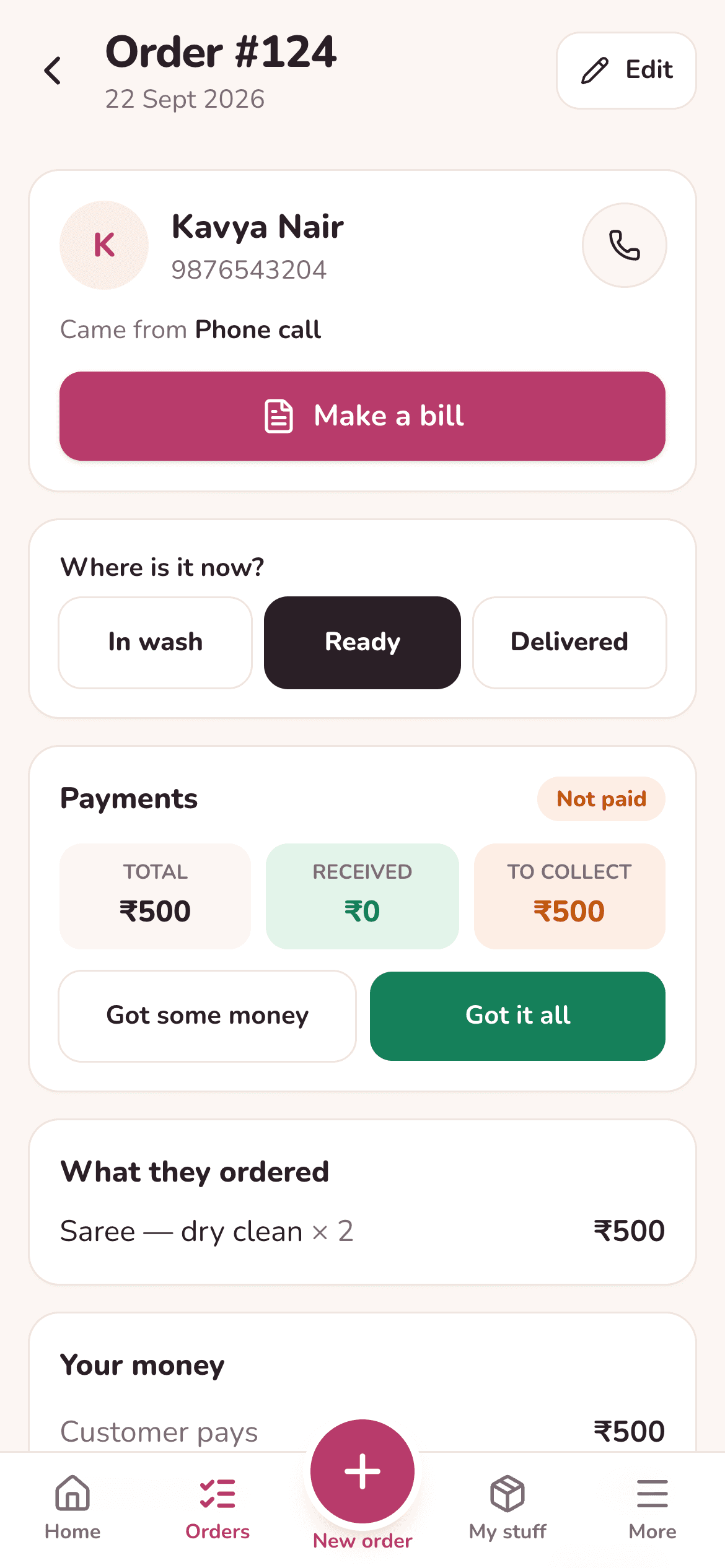
What Kipsy does that a general app doesn't
Counts pieces, not orders
Five shirts, two trousers and a saree on one slip, each at its own rate. Set the rates once and a drop-off takes seconds — or say it out loud while the customer is still at the counter.
Knows what is still in the shop, unpaid
Every order carries what has been collected and what has not. The clothes on the rail stop being a vague worry and become a list with a total at the bottom.
In wash, ready, delivered
It says what your shop says. An order sits in the wash until it is ready, with the day you promised it, so nothing is found at the back on Friday.
Shows what the month costs you
Rent, electricity, salary and water go out whether or not anybody walks in. Kipsy works out how many pieces cover them, and whether you are past that line.
And when an order falls through
A cancelled order with an advance already taken, or a garment that comes back — say what happened and the money going back is recorded against the same order. Until you hand it over, Kipsy says you are holding theirs.
One ordinary drop-off, worked through
Not a big order — the everyday kind, which is where a laundry's money actually comes from.
- 5 shirts, wash & press, at ₹40
- ₹200
- 2 trousers, wash & press, at ₹50
- ₹100
- 1 saree, dry clean
- ₹250
- Detergent, starch, covers and tags
- − ₹27
- Solvent and stain remover for the saree
- − ₹29
You kept ₹494 on a ₹550 slip. It took about 1 hour 20 minutes across washing, pressing and folding — so the work earned about ₹370 an hour, before the shop's own monthly costs come out of it.
Questions laundry & dry cleaning ask
Can I price each garment separately?
Yes. Set a rate once for a shirt, a trouser, a saree, a blanket, and a drop-off is a few taps — or one spoken sentence.
Does it tell me who has not collected their clothes?
Yes. Every order shows what has been paid and what has not, so the finished clothes waiting on the rail become a list with a total, not a worry.
Do I have to track detergent and covers?
Only if you want to. Many laundries skip it and put detergent and covers under monthly costs instead — the picture is then simply money in, minus what the shop costs to run.
Does it print tags or barcodes?
No. Kipsy is the money and the customers, not a tagging machine. If you run a token or barcode system, keep it — this sits alongside it.
Kipsy is also used by
Want one for your own business?
Free to start, and it takes about a minute — with Google, or with your email. Your first order can be one you simply say out loud.
Rather ask a person first? Message us on WhatsApp