
The cost is hidden in a hundred small purchases
Resin, ribbon, boxes, dried flowers, stickers, a marker, a bag of gold foil. Bought at different times, at different prices, used a little at a time across different orders. Working out what one hamper actually cost means remembering all of it — so almost nobody does, and the price ends up being whatever felt about right.
Festival season makes it worse, not better. That is when the volume arrives, and when a thin margin repeated thirty times does real damage.
What Kipsy does that a general app doesn't
Remembers what each material cost you
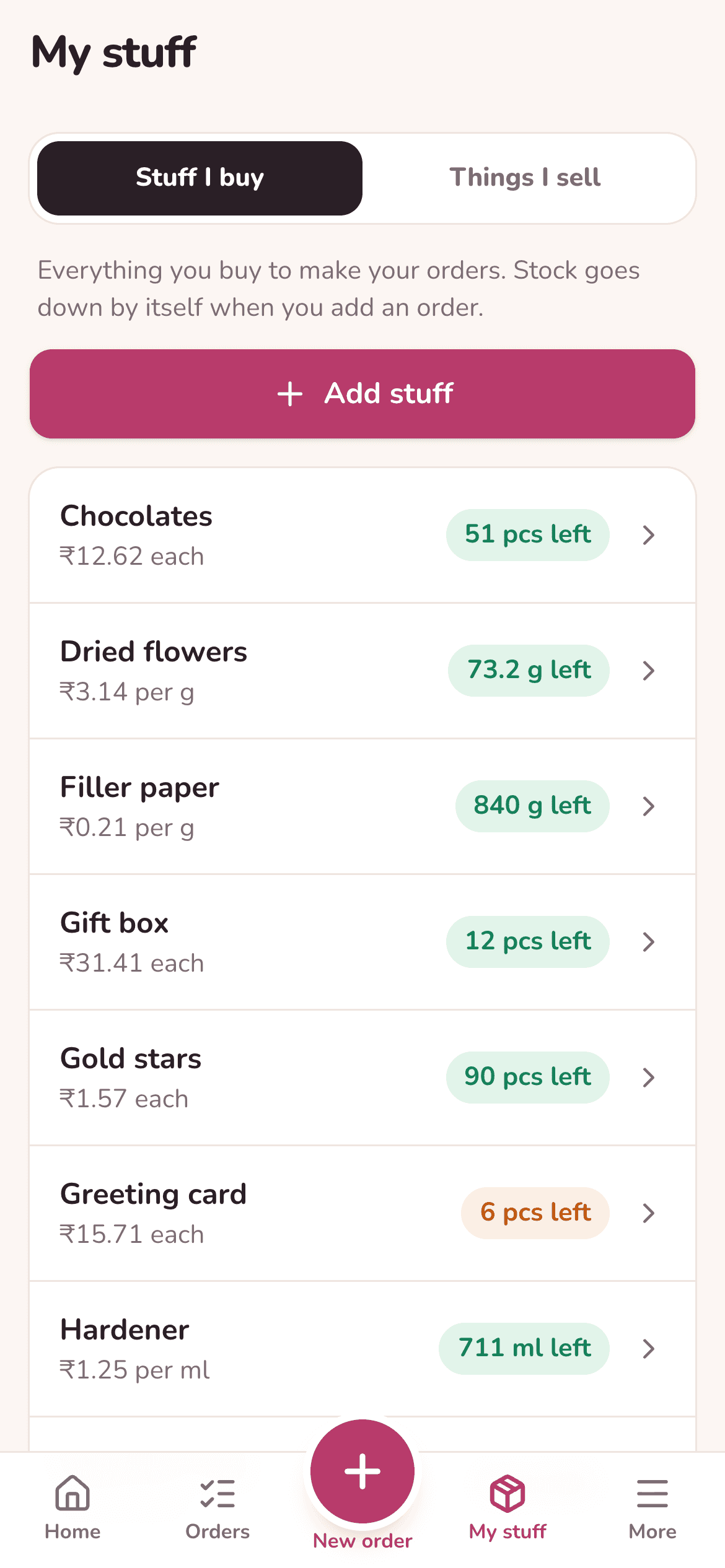
Buy 1.5 kg of resin for ₹1,350 and it works out the price per gram. Use 240 g in a tilak thali and that order carries ₹216 of resin — at the price you paid, frozen on the day you made it.
Handles one-off hampers
Most hampers are made once. Say what went into this one and the cost comes out; nothing has to be set up as a product first.
Keeps your costs off the customer's bill
The bill shows what they pay — items, delivery, discount. What the materials cost you and what you kept are never on it.
Tracks advances through the season
Half now, half on delivery, across thirty orders in a fortnight. Kipsy keeps who has paid what, so nothing is written off by accident.
When a piece comes back
One item out of a hamper returned, or the whole thing cancelled after an advance. Say how much came back and both the bill and the money correct themselves, on the order it belongs to.
Two tilak thalis, worked through
A real order, taken from the notes of the first business using Kipsy.
- Two thalis at ₹350
- ₹700
- Delivery charged to the customer
- ₹150
- Resin, 240 g at ₹0.90 a gram
- − ₹216
- Colour, ganesha, peacock, flowers, katori, foil, marker, sticks
- − ₹150
- Courier and packing you paid
- − ₹100
You kept ₹384. That is her own figure, to the rupee — the sum she used to do by hand on the back of the order list.
Questions gift hampers and handmade ask
Can it handle hampers that are all different?
Yes. Nothing has to be set up as a fixed product. Say or type what went into this particular hamper and it is costed from your own material prices.
How does it know what my materials cost?
You record what you bought and what you paid — 1.5 kg of resin for ₹1,350 — and Kipsy keeps the price per gram. When you buy more at a different price, it averages, so costs follow reality rather than a number typed in once.
Will my customer see what the hamper cost me?
Never. The bill shows only what they pay. Your material costs, packing, time and profit are not on it and cannot be put on it by accident.
Kipsy is also used by
Want one for your own business?
Free to start, and it takes about a minute — with Google, or with your email. Your first order can be one you simply say out loud.
Rather ask a person first? Message us on WhatsApp